Safety Data Sheets (SDSs) play a critical role in chemical hazard communication. But if your organization manufactures, formulates, or distributes chemicals across multiple regions, you already know that SDS requirements are not the same everywhere. The U.S., EU, and UK each maintain their own regulatory frameworks—aligned in some ways, yet different enough to cause compliance pitfalls.
This guide breaks down the core SDS obligations across the three regions and highlights where they overlap, differ, and require special attention.
Why SDS Requirements Differ Across Regions
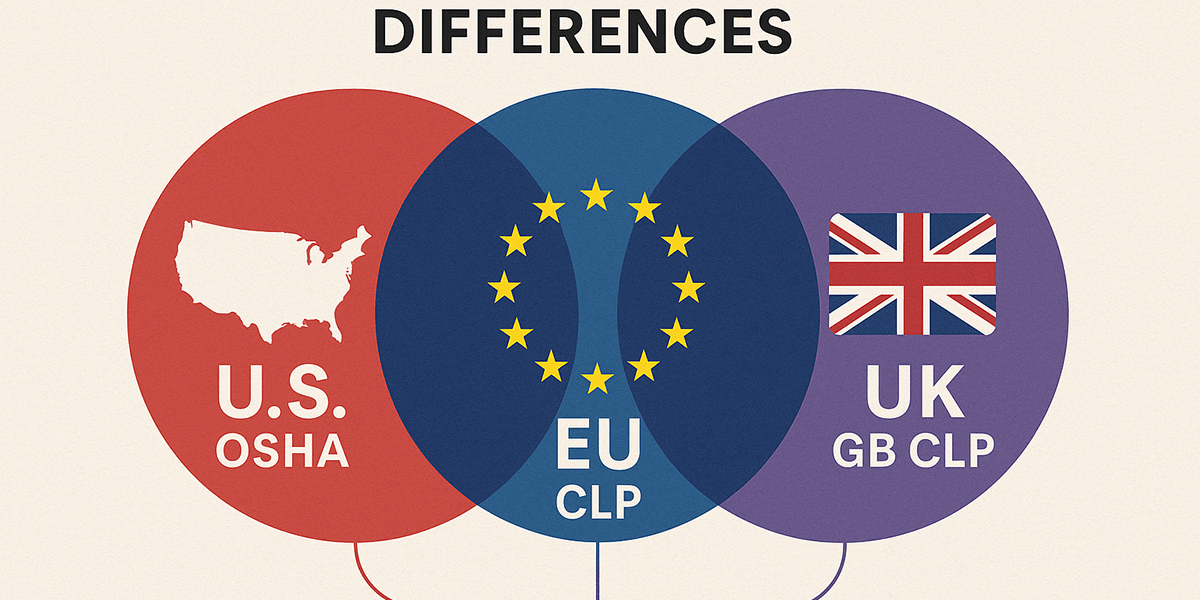
Even though all three markets base their chemical hazard communication rules on the UN Globally Harmonized System (GHS), each region implements a different revision of GHS, at different times, with region-specific adaptations. Add to that the complexities introduced by Brexit, and the compliance landscape becomes even more fragmented.
1. SDS Requirements in the United States (OSHA HazCom / GHS)
The United States regulates SDSs through OSHA’s Hazard Communication Standard (HCS).
Key U.S. SDS Considerations
-
Follows GHS Revision 3, with updates in progress.
-
The SDS must follow OSHA’s 16-section format, but Sections 12–15 are not mandatory, as OSHA does not enforce environmental or transport data.
-
OSHA hazard classifications differ from EU/UK CLP classifications.
-
U.S. SDSs must be written in English, though additional languages are permitted.
Common U.S. Challenges
-
Non-mandatory environmental sections can create difficulties when the same SDS is used globally.
-
GHS revisions are updated more slowly than in the EU or UK.
2. SDS Requirements in the European Union (EU CLP + REACH)
In the EU, SDSs are governed by REACH Annex II and the CLP Regulation (Classification, Labelling, and Packaging).
Key EU SDS Requirements
-
Follows GHS Revision 7/8, depending on updates.
-
Full 16-section SDS is required—all sections are mandatory.
-
Requires specific exposure scenarios for substances with REACH exposure-based obligations.
-
Strict formatting and wording rules, including specific phrases for hazards and precautions.
-
Must be provided in the official language(s) of each EU Member State where the chemical is marketed.
Common EU Challenges
-
Keeping SDSs aligned with frequent CLP ATPs (Adaptations to Technical Progress).
-
Managing exposure scenarios and extended SDS documentation.
-
Member State language variations and unique national requirements.
3. SDS Requirements in the United Kingdom (UK REACH + GB CLP)
Post-Brexit, the UK maintains SDS rules similar to the EU, but with an entirely separate regulatory system.
Key UK SDS Requirements
-
Based on UK REACH and GB CLP, which initially mirrored EU law.
-
SDS must comply with UK-adapted REACH Annex II.
-
Hazard classifications rely on GB MCLs (Mandatory Classification & Labeling), which may diverge from EU CLP over time.
-
SDS must be provided in English.
-
SDSs may need updating if UK MCLs differ from EU harmonized classifications.
Common UK Challenges
-
Divergence from EU CLP rules is growing, requiring separate SDSs for EU and UK markets.
-
Substances registered under EU REACH do not automatically carry over to UK REACH.
-
Suppliers must track changes in GB MCL lists to maintain compliance.
| Requirement | U.S. (OSHA) | EU (REACH/CLP) | UK (UK REACH/GB CLP) |
|---|---|---|---|
| GHS Version | Rev. 3 | Rev. 7/8 | Rev. 7/8 (UK version) |
| 16-Section SDS | Yes | Yes (all sections mandatory) | Yes (all sections mandatory) |
| Language | English | Official language of each Member State | English |
| Exposure Scenarios | Not required | Required for some substances | May be required (similar to EU) |
| Environmental Data | Optional | Mandatory | Mandatory |
| Regulatory Body | OSHA | ECHA | HSE |
When You Need Separate SDSs
You will need three distinct SDS versions if:
-
Your product classifications differ between EU CLP and GB CLP.
-
EU requires an extended SDS, but the U.S. does not.
-
Environmental or transport data differs by jurisdiction.
-
Concentration limits or hazard phrases vary between regions.
Best Practices for Global SDS Compliance
1. Maintain a Master SDS Template
A global master document helps ensure consistency while allowing for region-specific customization.
2. Track Regulatory Updates Quarterly
Especially:
-
EU CLP ATP updates
-
GB MCL updates
-
OSHA’s upcoming alignment rule changes
3. Use Regional Experts
Small classification differences can trigger the need for an entirely separate SDS—local expertise prevents costly errors.
4. Review SDSs Every 12–18 Months
Even if no updates seem necessary, regulators expect active document maintenance.
5. Don’t Rely on a Single SDS for Multiple Markets
Regulators increasingly scrutinize SDSs using incorrect hazard phrases or missing regional data.
Conclusion
Navigating SDS requirements across the U.S., EU, and UK is more complex than ever—especially given diverging regulations post-Brexit. While all three systems share a GHS foundation, regional nuances mean that a one-size-fits-all SDS is rarely compliant.
Organizations operating globally should invest in region-specific SDSs, maintain ongoing regulatory monitoring, and seek expert guidance to avoid non-compliance, supply-chain disruptions, and legal exposure.